

Princess-Cut Diamonds: A Brilliant Take on Geometry
Crisp corners and brilliant-style light. Discover the princess cut and what to consider when choosing a diamond with a bold geometric presence.
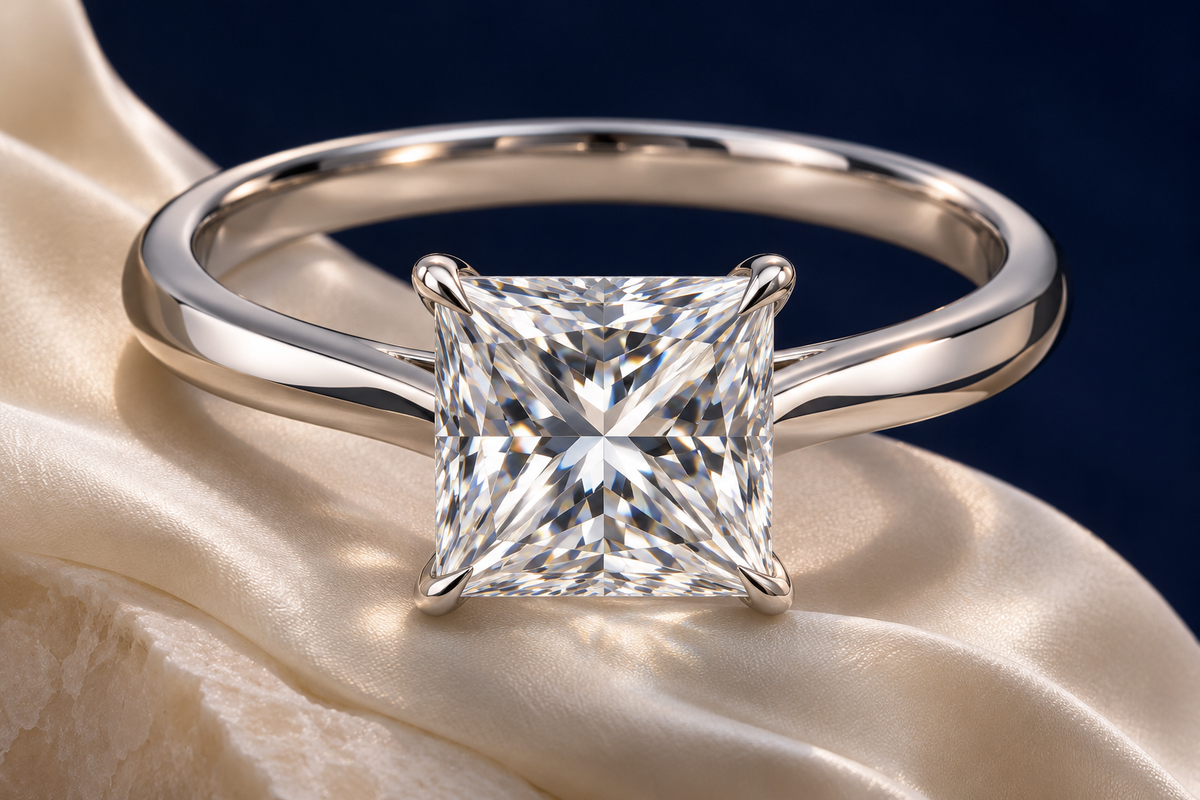
A princess-cut diamond brings a clear point of view to a ring: strong lines, sharp corners, and a geometric silhouette that holds its own.
What is a princess-cut diamond?
A princess-cut diamond is commonly square in outline with pointed corners and a modified brilliant facet arrangement. Some examples are more rectangular. The term princess cut refers to more than any square shape: a square cushion, for example, has a different outline and cutting character.
What gives princess diamonds their character?
The straight edges create a striking contrast with a curved band. A princess center can feel clean and contemporary in a solitaire, while side stones or a halo create a fuller composition. Its geometry also lends itself to coordinated diamond bands and matching jewelry.
How to choose your princess diamond
Pay attention to corner protection
The pointed corners need thoughtful protection in the setting. Ask how the prongs or bezel cover the vulnerable areas, and have the design assessed as a whole. A protective setting still needs regular inspection and sensible care.
Look at the face-up outline
If you prefer a square appearance, compare the length and width measurements as well as the photograph. A more rectangular stone can be attractive too; the important distinction is whether its outline matches what you want.
Judge the light pattern in motion
Princess diamonds can vary in their facet arrangements and visual texture. Request video in more than one lighting environment. A shape label alone cannot tell you how bright or lively an individual stone will appear.
Compare visible dimensions and the complete ring
Weight, measurements, color, clarity, setting construction, and metal all contribute to the final result. Ask how the diamond sits on the finger and whether the setting height suits the wedding band you plan to wear.
Princess diamonds vs. other shapes
A princess diamond emphasizes straight sides and pointed corners. A cushion softens the corners, while an emerald cut introduces clipped corners and step-like reflections. A round brilliant removes the angular outline entirely. Choose the balance of geometry and light that feels most like you.
Explore our cushion diamond guide and emerald diamond guide to compare the details.
Choosing a lab-grown diamond
Lab-grown describes origin, rather than a shape or a quality level. Ask to see the individual stone’s specifications and available grading report, confirm what is included in the complete ring, and compare the final design within your budget. Read more about lab-grown diamonds at Melden.
Princess diamond FAQs
Is a princess cut the same as a square cushion?
No. A princess generally has pointed corners and a modified brilliant facet arrangement; a cushion has rounded corners and its own range of facet styles.
Can I wear a princess-cut ring every day?
Many people do with an appropriate setting and care. Remove fine jewelry for heavy work and have the setting inspected periodically.
Can princess-cut diamonds be lab-grown?
Yes. Origin and shape are separate attributes. Confirm the actual stone’s specifications and the available grading report.
Explore princess diamond jewelry with Melden
Discover Melden’s princess diamond collection, or bring your ideas to a bespoke consultation. We help clients in Bentonville, Centerton, Rogers, Fayetteville, and online consider proportions, settings, and personal style. For a ring, begin with our free ring sizing kit and confirm the final fit before ordering.
Your shape. Your story.
Explore the details with personal guidance from Melden Fine Jewelers.
Book a private consultationExplore princess diamond jewelryFurther reading on diamond shapes and faceting: GIA educational reference.
Editorial image illustrates a ring style. Available Melden designs and specifications may differ.